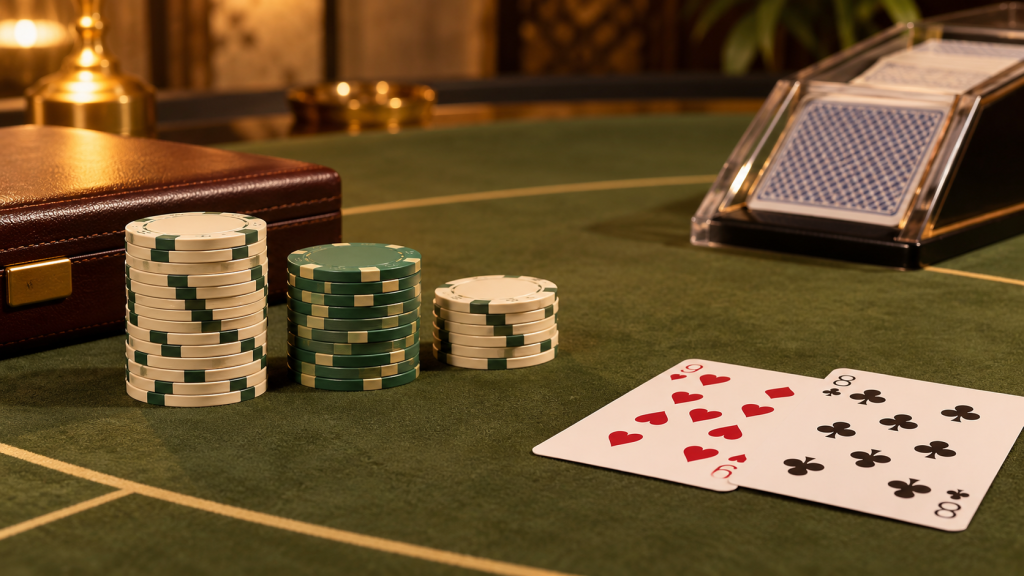
The third-card decision is one of the most misunderstood parts of Baccarat Banque. Some explanations borrow the automatic rules of Punto Banco, while others imply that every participant can draw freely on any total.
This superace88 guide separates the traditional player framework from the banker’s wider decision. Knowing which role you are reading about prevents those two ideas from becoming mixed together.
Check for a Natural Before Drawing
Each of the three hands begins with two cards. An initial eight or nine is a natural. Under the traditional natural procedure, a declared natural leads to exposure and settlement rather than an ordinary drawing stage.
Remember that card values are not blackjack values. Aces are one, tens and face cards are zero, and only the final digit of a total matters. Seven plus eight is five, while King plus nine is nine.
The Traditional Player Drawing Framework
If no natural has ended the round, the active representatives act for the two player hands.
| Player’s two-card total | Traditional action | Meaning |
|---|---|---|
| 0–4 | Draw | Receive one additional card |
| 5 | Choose | Either stand or draw |
| 6–7 | Stand | Keep the original two cards |
| 8–9 | Natural | Resolve through the natural-hand procedure |
The right-side hand traditionally acts first, followed by the left. A third card is exposed, giving the banker additional information without revealing the original two cards.
Why Five Requires Special Attention
A five is the player’s discretionary total in the traditional framework. Drawing can improve it, leave it unchanged or reduce its final baccarat value.
| Starting total | Third-card value | Final total |
|---|---|---|
| 5 | 0 | 5 |
| 5 | 3 | 8 |
| 5 | 5 | 0 |
| 5 | 9 | 4 |
These examples in the superace88 guide illustrate scoring only. They do not establish that drawing or standing is always best in every strategic setting.
The Banker Must Consider Two Opponents
After the player sides act, the banker chooses whether to take a third card. In the traditional Banque version described here, the banker is not bound by the standard Punto Banco drawing tableau.
The decision can consider the banker’s own cards, whether each player stood or drew, exposed third cards and the amount staked on each side. Because one hand faces two opponents, the interests of the two comparisons can conflict.
Why “Copy the Player” Is Incomplete
There are two player hands, and they may take different actions. The banker cannot simply copy both. A superace88 explanation that recommends a universal copying rule would leave out this central feature.
A Draw Can Make a Good Hand Worse
Suppose a five receives a six. The raw total becomes eleven and the final value becomes one. Baccarat has no bust, but it also has no promise that taking another card improves the hand.
This is why a drawing decision should be explained through the actual rules rather than phrases such as “another chance to get closer to nine.” The possible outcomes run in both directions.
Keep Decisions Separate from Betting Systems
Drawing strategy concerns the cards. A staking progression concerns the amount wagered. Doubling a bet after a loss does not improve the cards or guarantee recovery.
Use this superace88 article to understand the drawing stage, then confirm the specific table’s procedures and costs before making any wager.